Norway's Christian Jersey
Norway's Christian Jersey

The Pattern Inside the Cross
Norway's 2026 shirt puts a Christian cross on the chest and fills it with pagan ornament. That isn't a mistake. It's the most accurate thing about it.
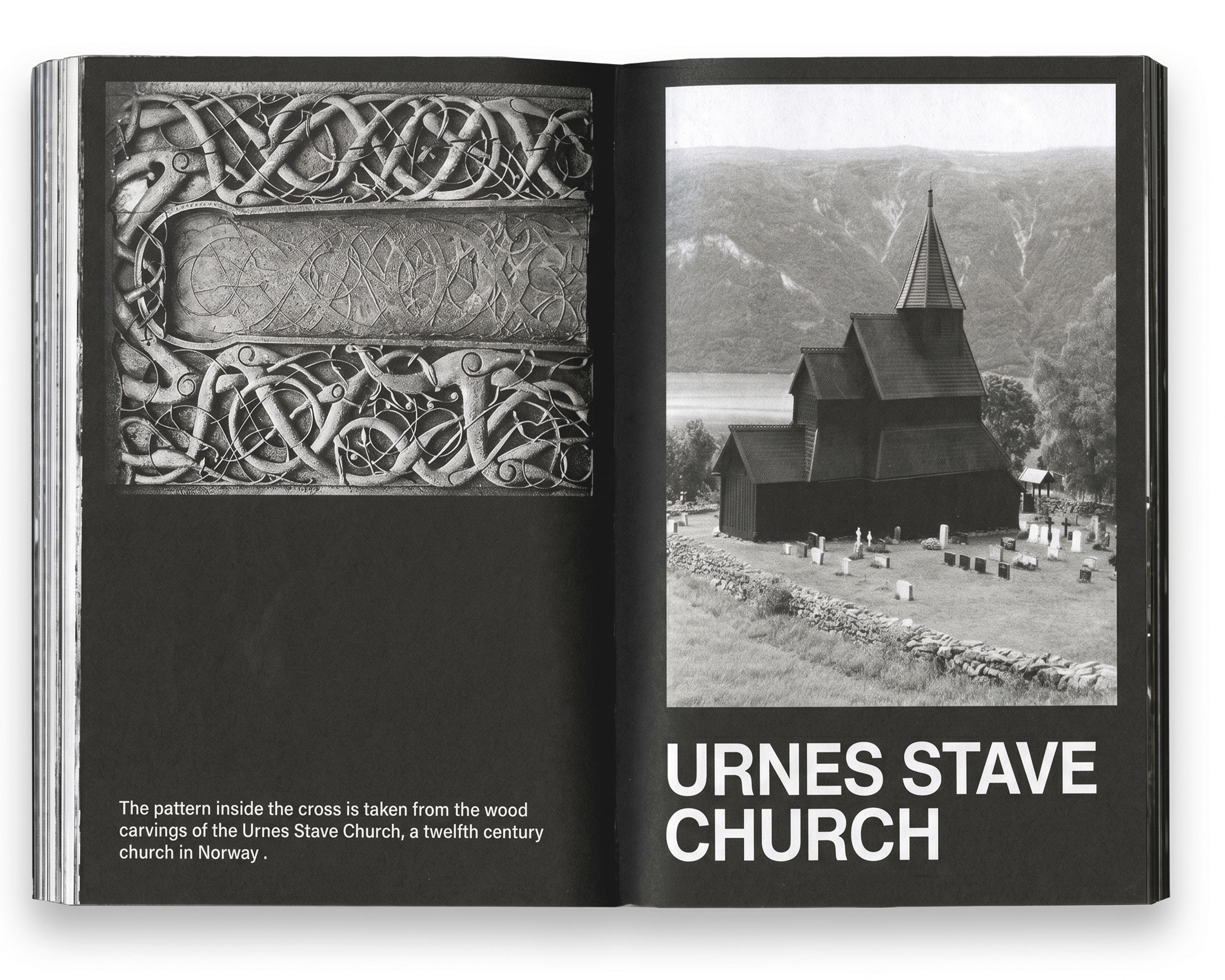
Norway went to the World Cup this summer for the first time since 1998, and Nike sent them in a red shirt with a navy Nordic cross across the chest, outlined in white, the federation crest sitting inside the cross itself. Look closer at the navy and there's a tonal pattern worked into it — interlaced, vine-like, animal. Nike took it from Urnes Stave Church.
Everyone reported this as the Christian kit. The cross from the flag, the pattern from a twelfth-century church. Case closed.
It's more interesting than that, and the correction came from a commenter under our own post: the pattern isn't Christian. It's Viking.
The style is named after the church, not the faith
Urnes Stave Church sits in Luster, in Sogn, and dates to around 1130. It's the oldest surviving stave church in Norway and the only one on UNESCO's World Heritage list, inscribed in 1979.
The carvings it's famous for — the north portal, the wall panels, all that interlaced animal and vine work — are the reason art historians use the term Urnes style. That style is the final phase of Viking Age ornamental art. Slim, stylised beasts wound through tendrils, the last flowering of Norse animal design before medieval Christian forms took over.
So the ornament isn't church decoration that happens to look Viking. It's Viking art that happens to be on a church. The style is named after a Christian building, and it is the closing chapter of a pagan tradition. Both things are true at once, which is the whole point of it.
There's a further wrinkle. The most celebrated carvings at Urnes are older than the church they're attached to — dated to roughly 1070, salvaged from an earlier building on the same site and reused when the current church went up around 1130. Archaeologists have found traces of three churches there before this one.
Which means the ornament was already secondhand when it got its Christian frame. It had been cut off one building and fixed onto another. In 2026 it got cut off again and printed on a football shirt.
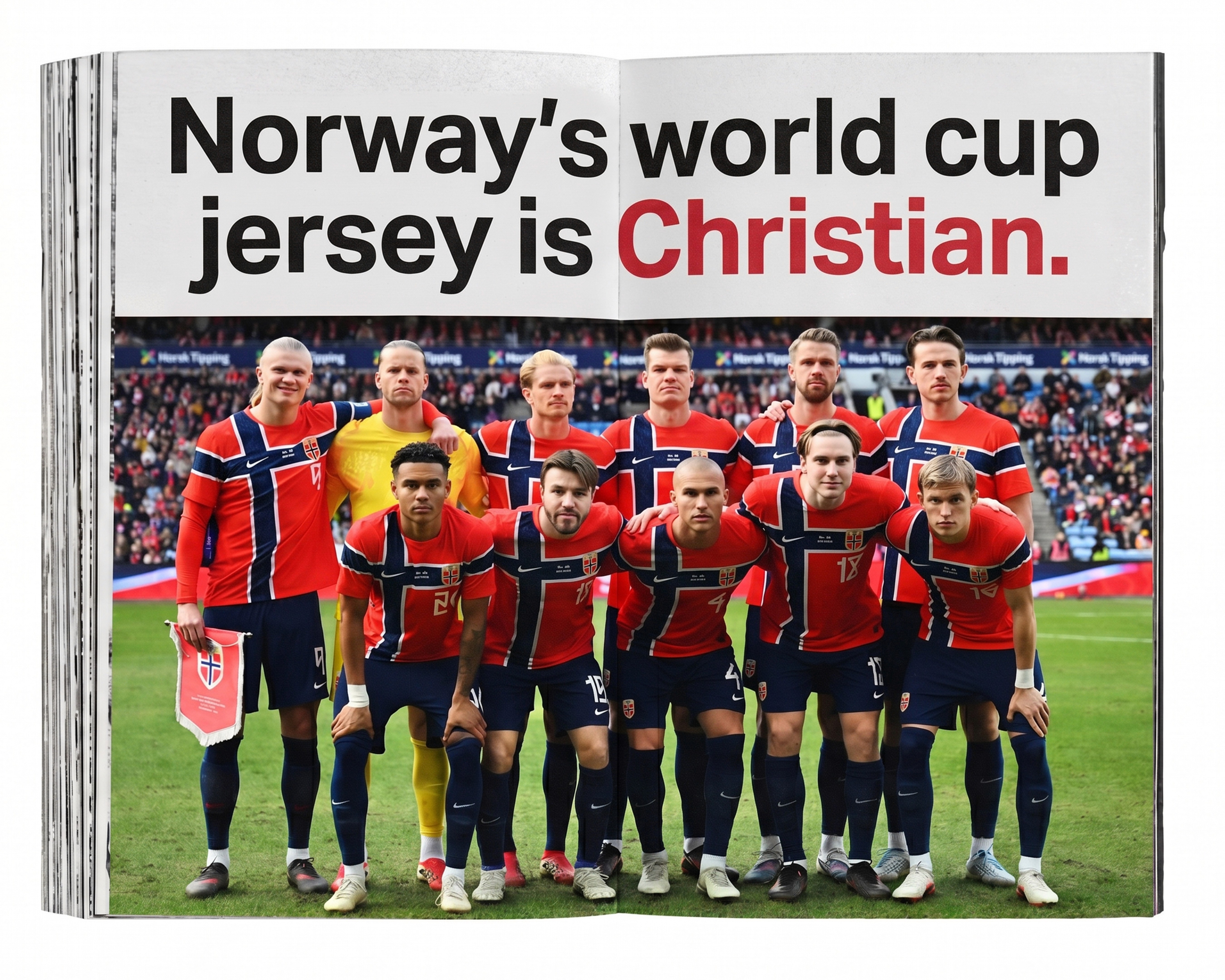
A Christian frame around a pagan pattern
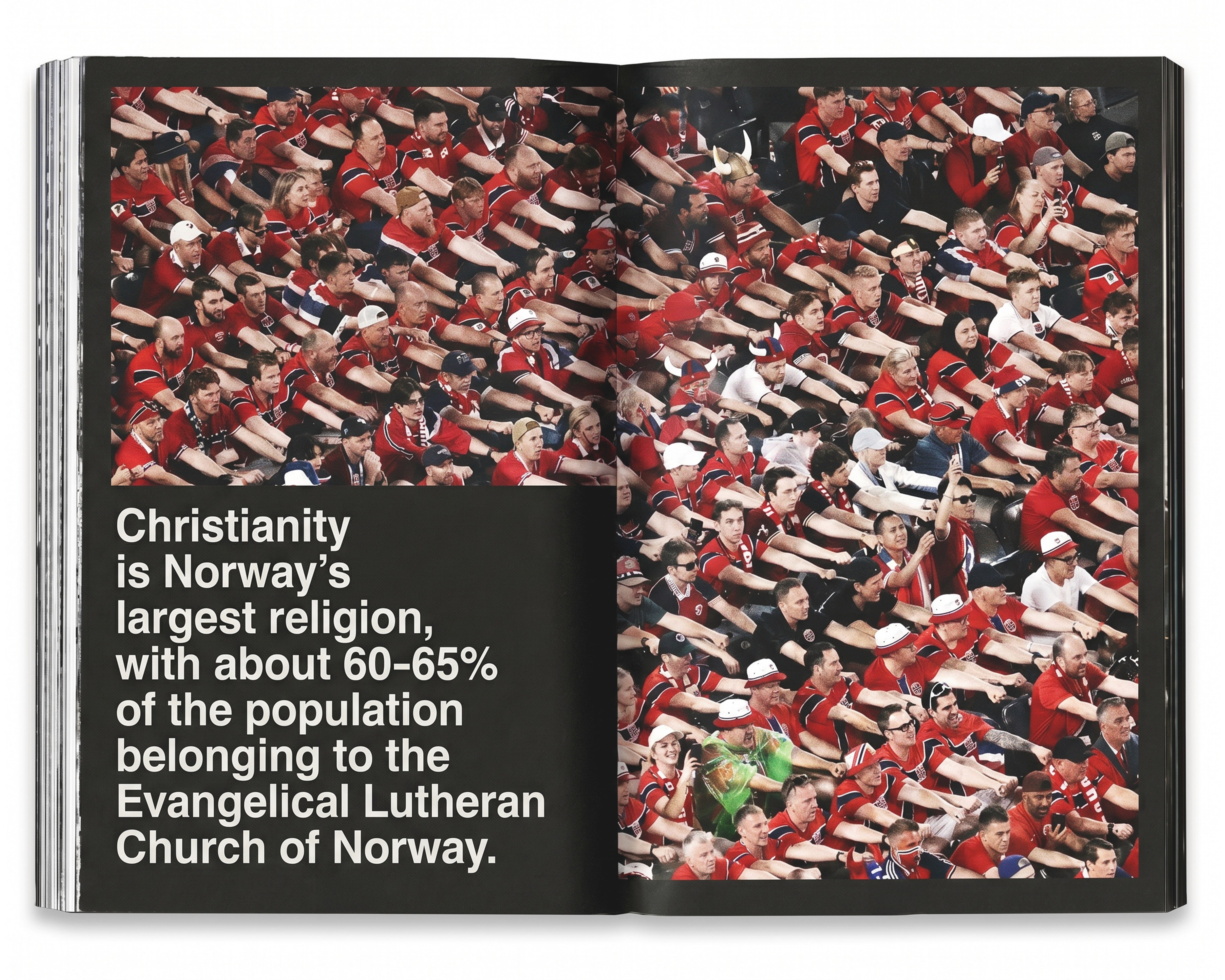
Put it plainly. The cross is real Christianity — it comes from the flag, and the flag comes from the Nordic cross that every Scandinavian country adopted after conversion. Roughly three in five Norwegians are still members of the Church of Norway, though that number has been falling for decades.
And inside that cross, filling it, is pre-Christian ornament made by people whose grandparents worshipped other gods.
That isn't a contradiction anyone at Nike needed to resolve. It's what Norwegian Christianity actually looks like. The conversion up there didn't erase what came before so much as absorb it — which is exactly what the carvers at Urnes were doing, putting old animals on a new church, in the decades when the question was still open.
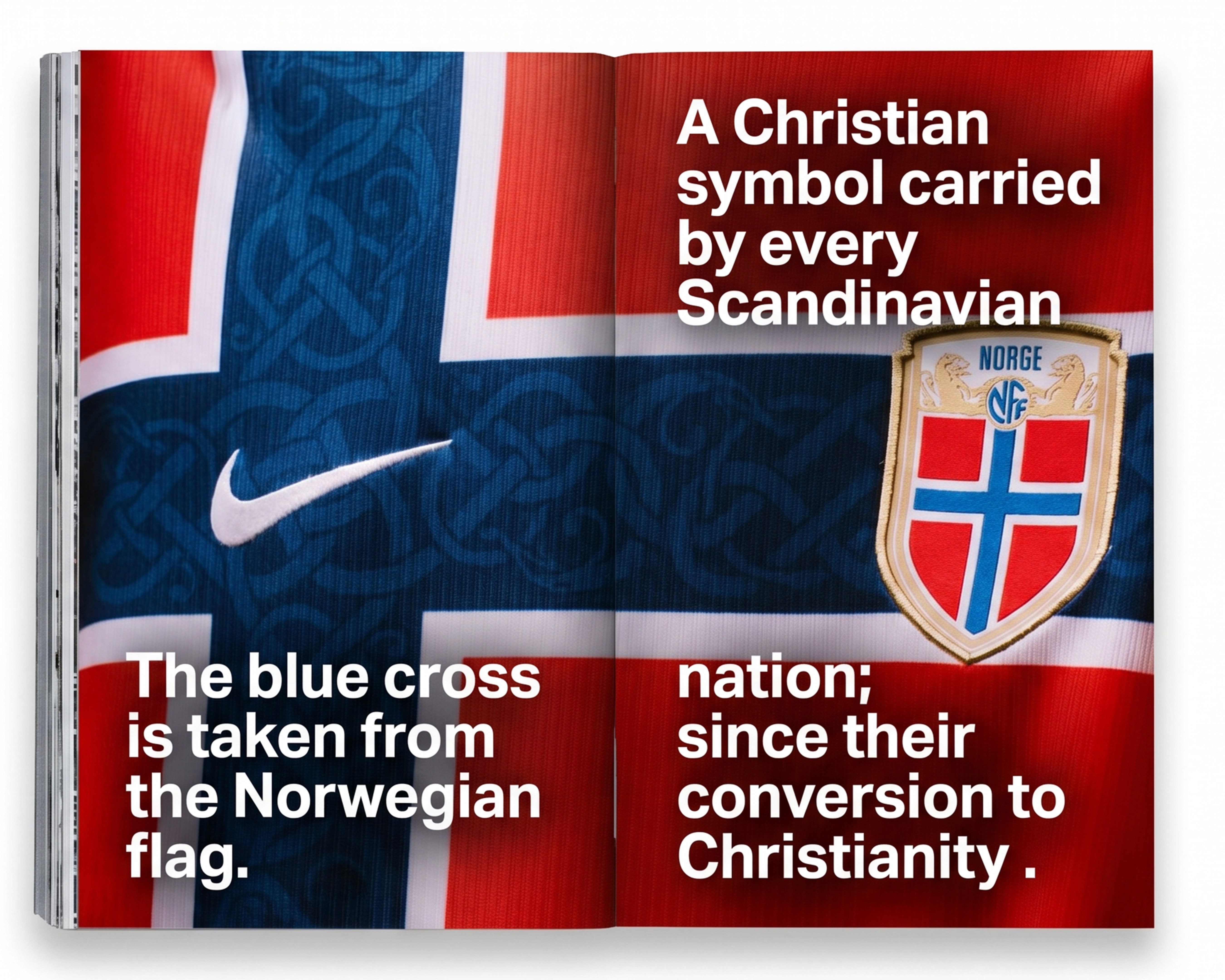
The font did the same thing
The kit's other story rhymes with it.
In 2024 Nike gave Norway a nameset called the Harald Typeface, drawn from runic geometry and the straight lines of sword metal. It appeared at the 2025 Women's Euro and the U20 World Cup, and FIFA banned it — two-tone numbers aren't permitted, and names and numbers have to read clearly at distance from Latin letterforms.
The replacement for 2026 is Taakeferd Condensed — journey through the fog, a nod to the 28 years Norway spent out of the tournament — built by Bergen designers Justin Tallian and Dan Gerhardstein and adapted by Nike for legibility. Strokes horizontal or vertical, diagonals held back for single moments inside a character, the foot of the L in Haaland flattened onto the baseline where the banned version kicked it up.
Same manoeuvre as the carvings. Take the old thing, put it in a container the current rules will accept, keep it legible without making it generic.
Worth noting whose name is on the back, too: Haaland plays for Norway as Braut Haaland, restoring his mother's surname — Gry Marita Braut, a national heptathlon champion in the nineties. In March he and his father bought the only surviving copy of the 1594 edition of Snorri Sturluson's Heimskringla, the sagas of the Norse kings, for 1.3 million kroner, and gave it to the public library in Bryne where he grew up. One condition: the book has to stay open, on display, where anyone can read it.
Ro
The part nobody designed: Norwegian fans in American stadiums sat down in rows and started rowing, chanting ro — to row, the way you would in a longship. No federation planned it. There's no evidence Viking rowers ever chanted anything like it.
They improvised it because the shirt had already told them what story they were in. Norway reached the quarter-finals for the first time in their history and lost 2–1 to England on 11 July.
The kit outlasts the result. And the thing on the chest was never one religion or the other. It's the seam between them, worn at speed.
We've added the ability to filter your collection lists in the CMS. This allows you to keep your content in a single collection, yet customize how that collection is presented on each of your web pages. For example, if you're creating docs for your app, you might want to filter articles per topic on your homepage. Or when creating a blog, you might want to filter your blog posts per category.
The Pattern Inside the Cross
Norway's 2026 shirt puts a Christian cross on the chest and fills it with pagan ornament. That isn't a mistake. It's the most accurate thing about it.
Norway went to the World Cup this summer for the first time since 1998, and Nike sent them in a red shirt with a navy Nordic cross across the chest, outlined in white, the federation crest sitting inside the cross itself. Look closer at the navy and there's a tonal pattern worked into it — interlaced, vine-like, animal. Nike took it from Urnes Stave Church.
Everyone reported this as the Christian kit. The cross from the flag, the pattern from a twelfth-century church. Case closed.
It's more interesting than that, and the correction came from a commenter under our own post: the pattern isn't Christian. It's Viking.
The style is named after the church, not the faith
Urnes Stave Church sits in Luster, in Sogn, and dates to around 1130. It's the oldest surviving stave church in Norway and the only one on UNESCO's World Heritage list, inscribed in 1979.
The carvings it's famous for — the north portal, the wall panels, all that interlaced animal and vine work — are the reason art historians use the term Urnes style. That style is the final phase of Viking Age ornamental art. Slim, stylised beasts wound through tendrils, the last flowering of Norse animal design before medieval Christian forms took over.
So the ornament isn't church decoration that happens to look Viking. It's Viking art that happens to be on a church. The style is named after a Christian building, and it is the closing chapter of a pagan tradition. Both things are true at once, which is the whole point of it.
There's a further wrinkle. The most celebrated carvings at Urnes are older than the church they're attached to — dated to roughly 1070, salvaged from an earlier building on the same site and reused when the current church went up around 1130. Archaeologists have found traces of three churches there before this one.
Which means the ornament was already secondhand when it got its Christian frame. It had been cut off one building and fixed onto another. In 2026 it got cut off again and printed on a football shirt.
A Christian frame around a pagan pattern
Put it plainly. The cross is real Christianity — it comes from the flag, and the flag comes from the Nordic cross that every Scandinavian country adopted after conversion. Roughly three in five Norwegians are still members of the Church of Norway, though that number has been falling for decades.
And inside that cross, filling it, is pre-Christian ornament made by people whose grandparents worshipped other gods.
That isn't a contradiction anyone at Nike needed to resolve. It's what Norwegian Christianity actually looks like. The conversion up there didn't erase what came before so much as absorb it — which is exactly what the carvers at Urnes were doing, putting old animals on a new church, in the decades when the question was still open.
The font did the same thing
The kit's other story rhymes with it.
In 2024 Nike gave Norway a nameset called the Harald Typeface, drawn from runic geometry and the straight lines of sword metal. It appeared at the 2025 Women's Euro and the U20 World Cup, and FIFA banned it — two-tone numbers aren't permitted, and names and numbers have to read clearly at distance from Latin letterforms.
The replacement for 2026 is Taakeferd Condensed — journey through the fog, a nod to the 28 years Norway spent out of the tournament — built by Bergen designers Justin Tallian and Dan Gerhardstein and adapted by Nike for legibility. Strokes horizontal or vertical, diagonals held back for single moments inside a character, the foot of the L in Haaland flattened onto the baseline where the banned version kicked it up.
Same manoeuvre as the carvings. Take the old thing, put it in a container the current rules will accept, keep it legible without making it generic.
Worth noting whose name is on the back, too: Haaland plays for Norway as Braut Haaland, restoring his mother's surname — Gry Marita Braut, a national heptathlon champion in the nineties. In March he and his father bought the only surviving copy of the 1594 edition of Snorri Sturluson's Heimskringla, the sagas of the Norse kings, for 1.3 million kroner, and gave it to the public library in Bryne where he grew up. One condition: the book has to stay open, on display, where anyone can read it.
Ro
The part nobody designed: Norwegian fans in American stadiums sat down in rows and started rowing, chanting ro — to row, the way you would in a longship. No federation planned it. There's no evidence Viking rowers ever chanted anything like it.
They improvised it because the shirt had already told them what story they were in. Norway reached the quarter-finals for the first time in their history and lost 2–1 to England on 11 July.
The kit outlasts the result. And the thing on the chest was never one religion or the other. It's the seam between them, worn at speed.
We've added the ability to filter your collection lists in the CMS. This allows you to keep your content in a single collection, yet customize how that collection is presented on each of your web pages. For example, if you're creating docs for your app, you might want to filter articles per topic on your homepage. Or when creating a blog, you might want to filter your blog posts per category.